March Lawn Care: What to Do Right Now


Crabgrass germinates when the 24-hour mean soil temperature averages about 53-55°F at a 2 to 4 inch depth for several consecutive days, according to NC State TurfFiles. Your pre-emergent has to be down before that, which in much of the country means March.
The forsythia in my front yard bloomed on March 14th last year. That’s my crabgrass pre-emergent trigger. My soil probe read 53-56°F at 4 inches that week, and I had Scotts Halts down that Saturday afternoon. By the time my neighbor noticed his crabgrass shoots in late April, my barrier had been down for six weeks. The forsythia rule isn’t perfect, but it beats the calendar.
March is when last year’s preparation either pays off or it doesn’t. If you calibrated your spreader in February and bought pre-emergent in January, you walk the lawn once and you’re done. If you waited, you’re in line at the garden center on March 28th hoping the forecast holds one more weekend. Same products. Different outcome.
What Should Cool-Season Lawns Do in March?
Cool-season grasses in Zones 4-7 break dormancy in March. Greenup moves from south to north: Zone 7 first, then Zone 6, then Zone 5 into April.
Apply Pre-Emergent Before the Crabgrass Window Opens
This is the month’s binding decision. Apply pre-emergent (prodiamine or pendimethalin) while soil temps are still climbing through the low 50s, before NC State’s germination mark of a 53-55°F daily mean at 2 to 4 inches for several days. In Zone 7 that is usually early to mid March. In Zones 5-6, mid to late March. UW-Madison Extension says forsythia bloom often precedes crabgrass germination and can serve as the timing indicator.
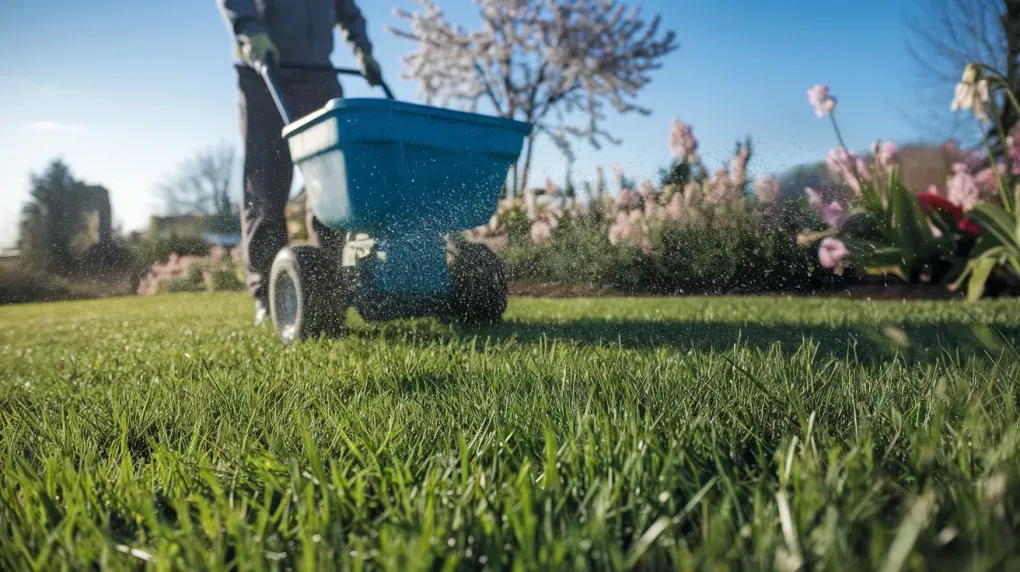
Use a calibrated broadcast spreader. The Scotts Turf Builder EdgeGuard DLX is the entry-level pick. Apply at the labeled rate and water it in as the label directs. UW-Madison advises waiting until late August or early September to dethatch after a pre-emergent, and the Barricade 4FL label warns that disturbing the herbicide barrier may reduce weed control.
First Mow When Active Growth Resumes
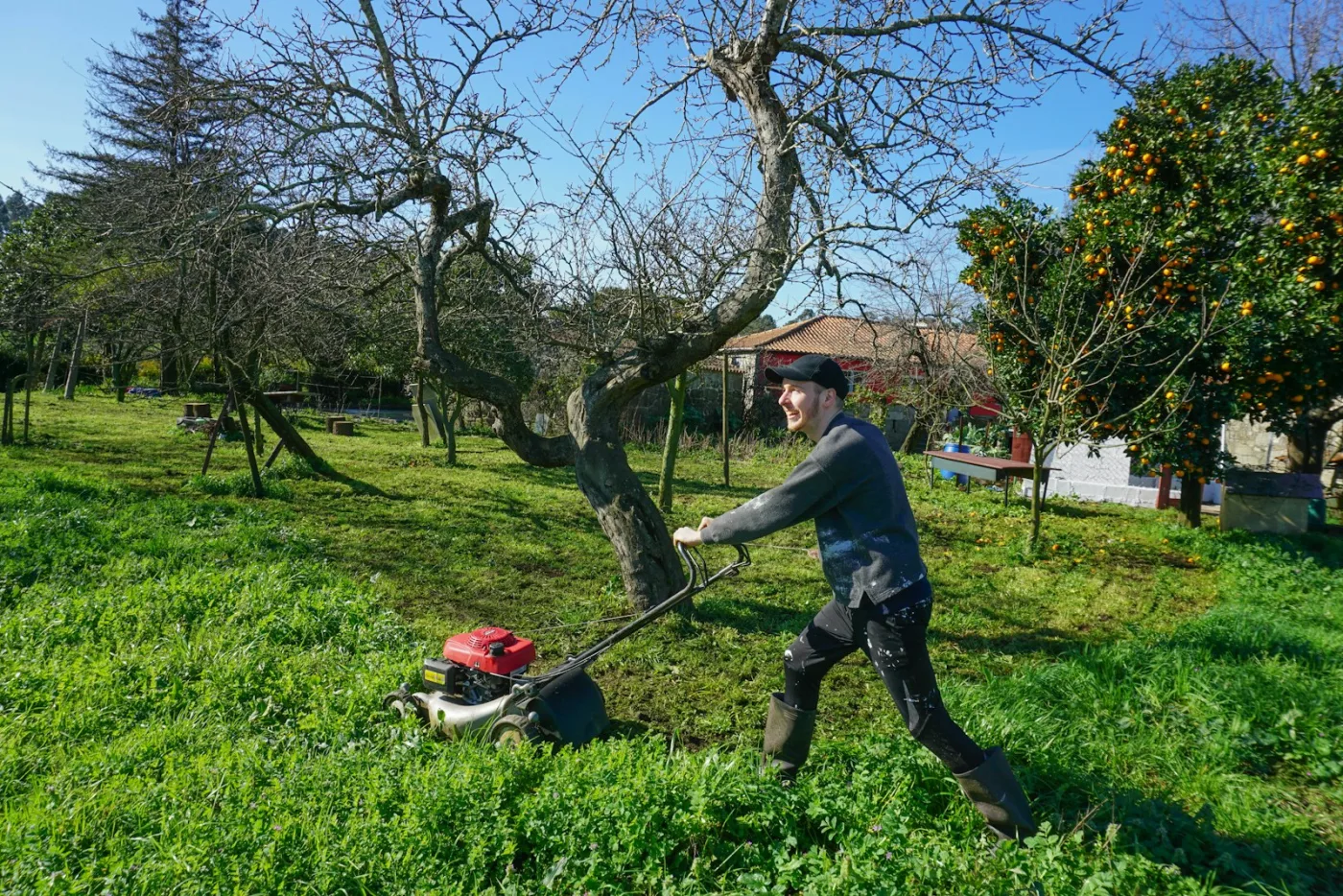
The first mow happens when the grass is actively growing — typically when blade length reaches 3-4 inches in early spring. Mow at your normal height (3-3.5 inches for KBG and ryegrass, 3.5-4 inches for tall fescue). Don’t scalp — never remove more than one-third of the blade in a single cut.
Sharpen the mower blade if you didn’t already. A dull blade tears grass tips, creating fungal entry points that show up as yellow lesions in May.
First Light Fertilizer Application
A light early-spring fertilizer (about 0.5 lb of nitrogen per 1,000 sq ft) supports the active growth that’s beginning in the top inch of soil. Use a balanced fertilizer like Scotts Turf Builder or a starter fertilizer if you’re seeding bare patches.
Skip the heavy spring fertilizer. The most important fertilizer application of the year goes down in September-October, not March. Heavy March fertilization pushes top growth at the expense of root development — exactly the opposite of what cool-season lawns need heading into summer.
Spot-Treat Early Broadleaf Weeds
Dandelions, henbit, and chickweed appear in March. Spot-treat with a 2,4-D + dicamba product using a 2-gallon pump sprayer like the Chapin 20002. Spray when temps are between 55-80°F and weeds are actively growing. Cold-stressed weeds don’t absorb herbicide well — wait for a warm afternoon if morning temps are still in the 30s-40s.
What Should Warm-Season Lawns Do in March?
Warm-season grasses in Zones 7-10 begin breaking dormancy in March. Greenup progresses from coastal/southern areas inland and northward. Don’t fertilize until you see 50% green-up — fertilizing dormant warm-season grass throws money at weeds.
Pre-Emergent Final Window
For Zones 7-8, March is the final pre-emergent window, and often late. NC State TurfFiles recommends pre-emergent by March 1 in southeastern North Carolina and says to move traditional dates up about two weeks, because crabgrass has emerged in late February in recent years. Crabgrass germinates at a 53-55°F soil mean. Goosegrass waits for 60-65°F, usually at least two weeks later (NC State Extension), so it may need its own second application. See our goosegrass guide.
First Mow After 50% Green-Up
Wait until your bermuda, zoysia, or St. Augustine is at least half green before the first mow. Mow at the species-appropriate height (1-2 inches for bermuda, 2-3 inches for zoysia, 3-4 inches for St. Augustine). Don’t scalp the lawn early — early scalping stresses the grass while it’s still using stored energy reserves to break dormancy.
Hold Off on Fertilizer Until 50% Green-Up
Fertilizing dormant warm-season grass wastes nitrogen on cool-season weeds. Wait for visible greenup. Soil temps at 4 inches reaching 65°F is another reliable indicator — verify with a probe thermometer.
Why the Pre-Emergent Window Is March’s Priority
Pre-emergent herbicides only work before crabgrass germinates. The Barricade 4FL label says it will not control weeds that have already emerged. After that, you are into post-emergent products, and those get harder as plants grow.
The Acclaim Extra label shows how fast. Its rate for annual grassy weeds such as crabgrass is 3.5 fl oz per acre at the 1 to 2 leaf stage and 39 fl oz per acre at 4 to 5 tillers. That is about eleven times more product for the same weed, and the label caps a single application at 28 fl oz on Kentucky bluegrass. Miss the March window and the June fix costs more product per acre, if your grass can legally take it at all. Product prices vary by retailer, so we give the rates, not a dollar figure.
UConn Extension notes a single crabgrass plant can produce over 150,000 seeds. Skipping a year refills the seedbank.
Get the pre-emergent down. Time it with a soil thermometer. The rest of the spring becomes execution, not crisis management.
March Quick-Reference Checklist
Cool-Season (Zones 4-7):
- Apply pre-emergent (prodiamine or pendimethalin)
- First mow at proper height (don’t scalp)
- Light early-spring fertilizer (0.5 lb N/1,000 sqft)
- Spot-treat early broadleaf weeds
- Soil-test if not done in fall (results inform April-May plan)
Warm-Season (Zones 7-10):
- Apply pre-emergent before soil reaches a 53-55°F mean (crabgrass); plan a later round for goosegrass
- First mow after 50% green-up
- Hold off on fertilizer until 50% green-up
- Inspect irrigation system before spring water use
- Spot-treat winter-annual weeds before they set seed
Frequently Asked Questions About March Lawn Care
Is the forsythia rule actually accurate?
It’s a rough proxy, and the extension sources support it. UW-Madison says forsythia bloom often precedes crabgrass germination. UConn says crabgrass typically germinates sometime after forsythia bloom and before lilac or dogwood bloom. So forsythia in bloom means apply now, not wait. For a firmer read, check soil temperature with a probe thermometer and apply before the 53-55°F mark NC State uses.
Can I aerate in March?
I’d skip it. The Barricade 4FL label warns that disturbing the herbicide barrier with cultural practices may reduce weed control. The label does not put a number on that risk, and we have not found an extension source that quantifies it for core aeration. It is still an easy risk to avoid. Plan core aeration for September (cool-season) or early summer (warm-season at full growth).
Can I overseed in March?
Generally no for cool-season lawns. Standard pre-emergents also stop grass seed; the Barricade 4FL label, for example, requires 4 to 5 months between a 21 fl oz per acre application and overseeding. If you must seed in spring, Rutgers names two options that are safe at seeding: siduron (Tupersan) and mesotrione, which is in Scotts Turf Builder Starter Food for New Grass Plus Weed Preventer. Rutgers adds that neither is as effective as prodiamine or pendimethalin on established lawns. September is still the better seeding window.
Should I dethatch?
For cool-season lawns, no. UW-Madison advises waiting until late August or early September to dethatch when you’ve applied a pre-emergent. For warm-season lawns, late spring (May-June, after full greenup) is the correct dethatching window if needed. Most healthy lawns don’t need dethatching. They need core aeration, which solves the same drainage issues without the surface damage.
What’s the best mower blade for early-spring growth?
A standard mulching blade works for spring growth. For wet-grass conditions common in early spring, a high-lift blade gives better discharge but produces more grass-clipping clumps. Sharpen the blade now; check it again in mid-summer. The signal that a blade needs sharpening: torn tips on grass blades visible after mowing. Healthy, sharp-cut grass tips heal cleanly within 48 hours.
What’s Coming in April?
April is the spring growth peak: the second fertilizer application, weekly mowing schedule, and weed control follow-up. We cover the active-growth tasks in detail next month. See our April lawn care guide for the full breakdown.
Lawn Care Year Navigation
| Previous | Hub | Next |
|---|---|---|
| ← February lawn care | 📅 Annual Calendar | April lawn care → |
Season hub: Spring Lawn Care Guide: full three-month spring program with cool-season and warm-season specifics.
Related Resources
- Annual Lawn Care Calendar: the complete 12-month schedule
- Spring Lawn Care Complete Checklist: full 12-week spring program
- Best Fertilizer Spreaders: calibrated equipment for pre-emergent
- Best Lawn Fertilizers: spring fertilizer ratios and product picks
- Tall Fescue Care Guide: first fertilizer timing
- Kentucky Bluegrass Guide: pre-emergent and first mow
Sources
- NC State TurfFiles, Fred Yelverton: Timing of Preemergent Herbicide Applications (crabgrass germination at a 53-55°F soil mean; earlier application dates)
- NC State Extension: Goosegrass (germination at 60-65°F, at least two weeks after crabgrass)
- UW-Madison Extension: Crabgrass Management in Lawns (forsythia indicator; dethatching after pre-emergent)
- UConn Home & Garden Education Center: Crabgrass Control (forsythia and lilac timing; seeds per plant)
- Rutgers Center for Turfgrass Science: Weed Control in Spring Seedings (siduron, mesotrione, Scotts starter product)
- Barricade 4FL label (barrier disturbance caution; no control of emerged weeds; overseeding intervals)
- Acclaim Extra label (post-emergent rates by growth stage)