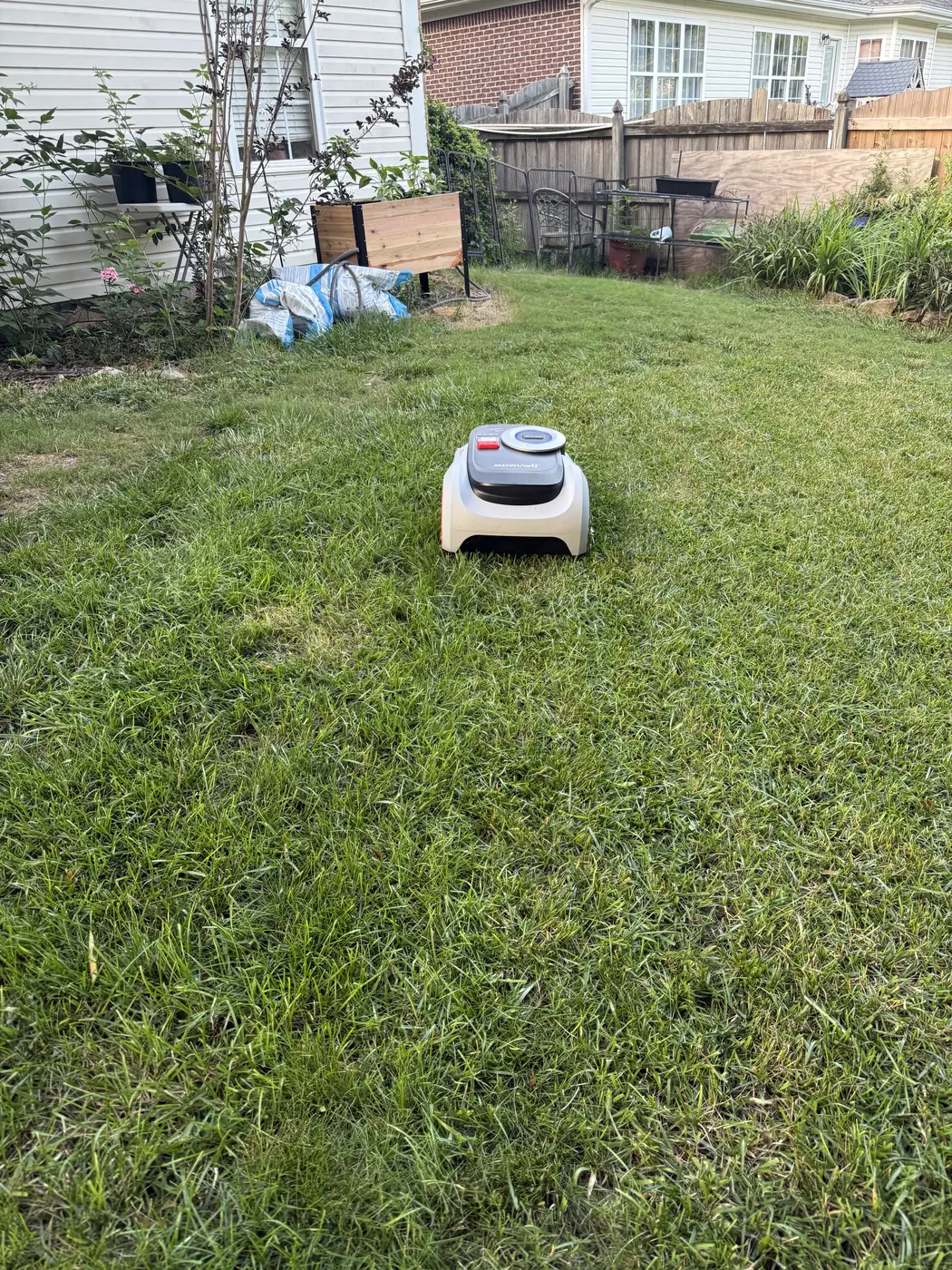
First-hand · Rob's home test lawn — an enclosed residential backyard with mature shrub beds, a wooden boardwalk edge, and partial tree cover · 2026-06-08
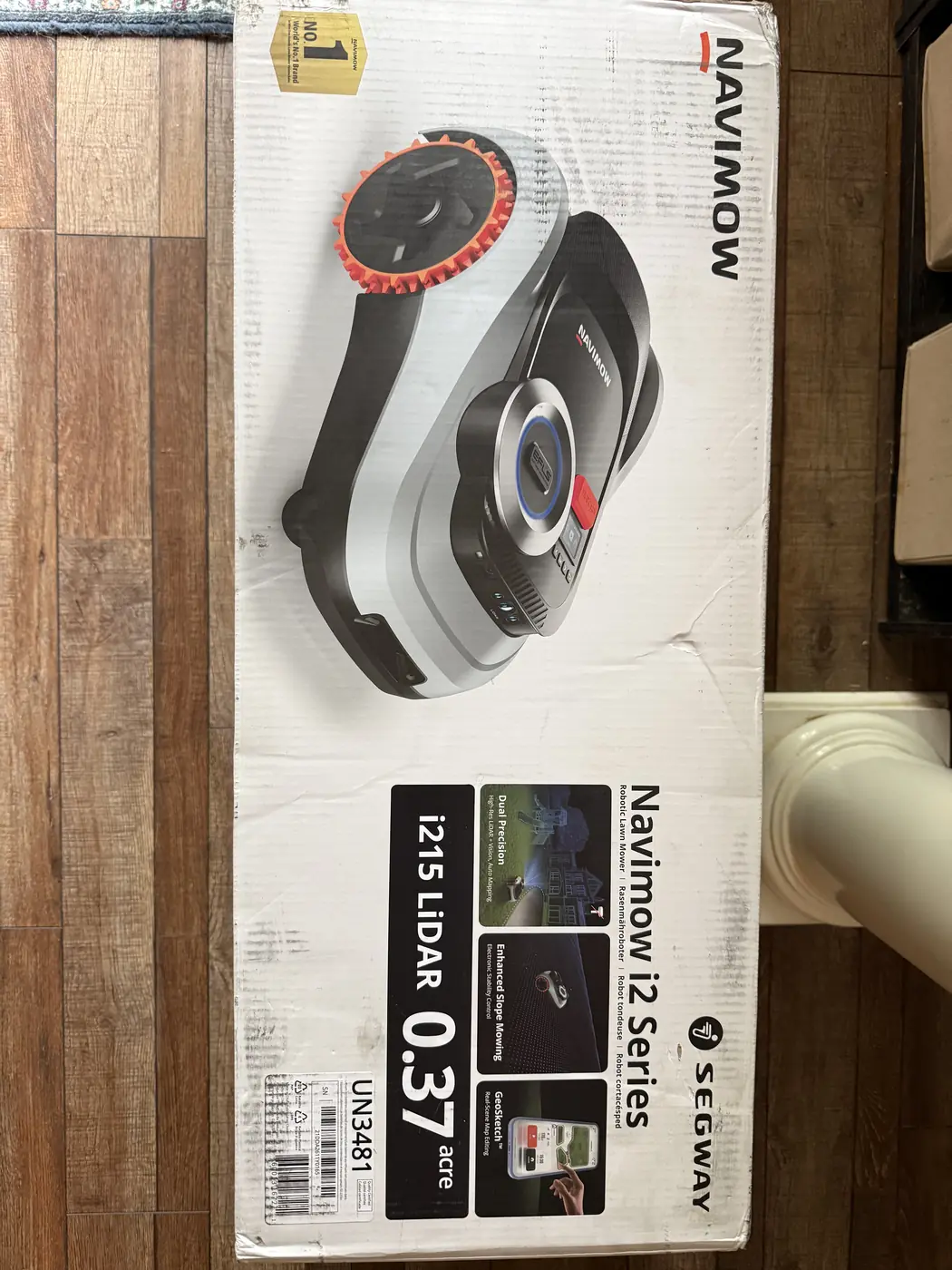
Sealed box to powered-on and docked in nine minutes — our own photo timestamps run 16:51 to 17:00 — with no antenna to site, no wire to bury, and no sky-view survey to perform.
Navimow i2 LiDAR Review (i215): What the Manual Says That the Spec Sheet Doesn’t
by Segway Navimow
The Navimow i2 LiDAR is the first robotic mower we've handled that doesn't ask the sky for permission. Every other wire-free machine in this price class — including Navimow's own X-series — positions itself with RTK satellite correction, which means an antenna with a clear view up, or a dependency on network RTK coverage at your address. Trees break it. Rooflines break it. The i215 replaces all of that with a solid-state LiDAR unit and a pair of vision cameras that build the map from onboard sensing. Our unit came out of the box on June 8, 2026. What follows is what we saw, plus what we found when we pulled the official service manual and compared it line-by-line against Navimow's own marketing — which turns out to disagree with itself in four places.
The first mower in our coverage where tree canopy and darkness stop being failure conditions — held back by rear-wheel drive, a boundary slope limit marketing never mentions, and a coverage rate that turns 0.37 acre into a day-and-a-half job.
- Best for: shaded, tree-heavy, obstacle-dense backyards under 0.37 acre where RTK mowers lose their fix
- Skip if: your slope runs out to the property line (boundary limit is 14°, not the advertised 24°) or you want a one-session cut
- Slope: 45% / 24° inside the working area, but only 25% / 14° at the mapped boundary — rear-wheel drive, not AWD
Nine minutes, box to dock
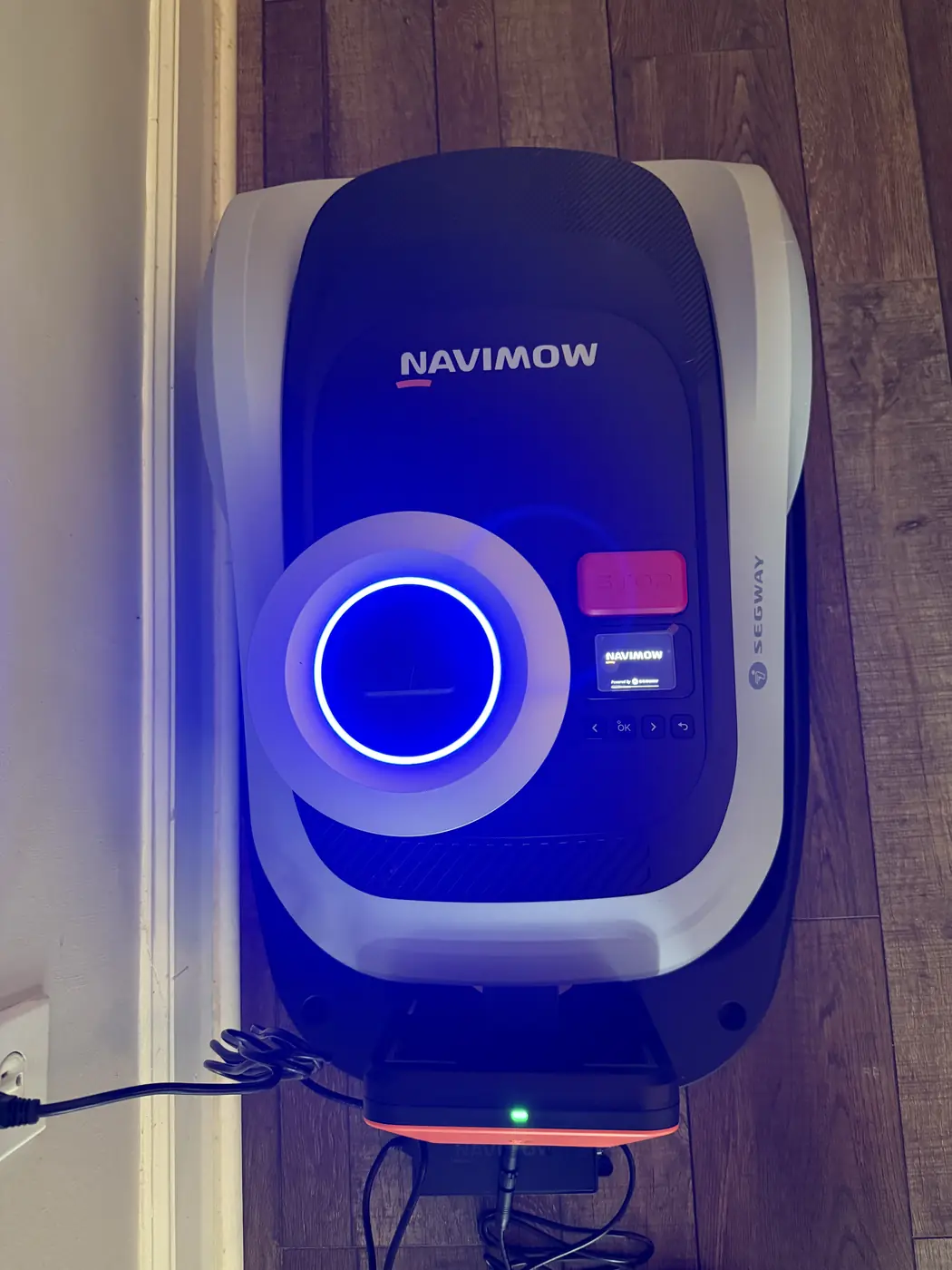
The setup claim Navimow leads with is "Drop and Mow," and it is the part of this product that most deserves the marketing. Our photo timestamps make an unusually clean record of it: the sealed retail box at 16:51, the machine out and inspected at 16:55, seated on its charging station at 16:56, and booted with the EFLS ring lit at 17:00. Nine minutes, on June 8, 2026, with no antenna mast to position, no perimeter wire to trench, and no walk around the yard hunting for a spot with enough open sky.
That is the difference the LiDAR buys you, and it shows up before the mower has cut a single blade. Setting up an RTK machine means solving a siting problem first: the antenna needs sky, the sky needs to not be full of oak, and if your yard fails that test you find out after you have already bought the mower. The i215 skips the entire category of problem.
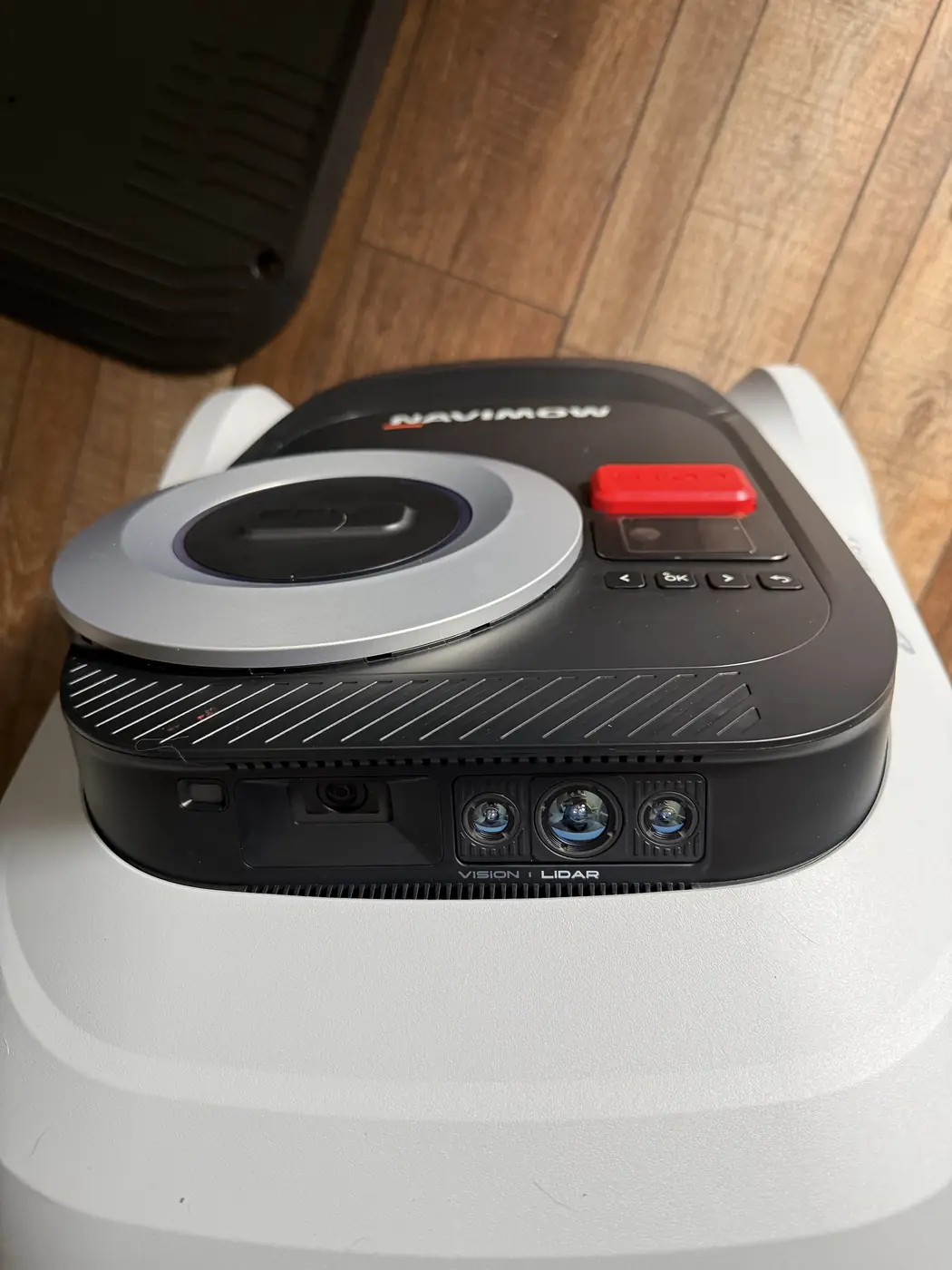
The sensor stack, up close
The front of the machine is where the money went. Behind the bumper line sits a module labelled, in plain text, VISION | LIDAR — three LiDAR apertures flanked by a camera housing. Navimow rates the solid-state unit at roughly 200,000 points per second, a 230-foot range, and a 50-millisecond scan interval. Solid-state matters here for a reason that has nothing to do with resolution: there is no spinning mirror assembly to wear out or knock out of alignment, on a device whose entire job is to be repeatedly bounced off tree roots.
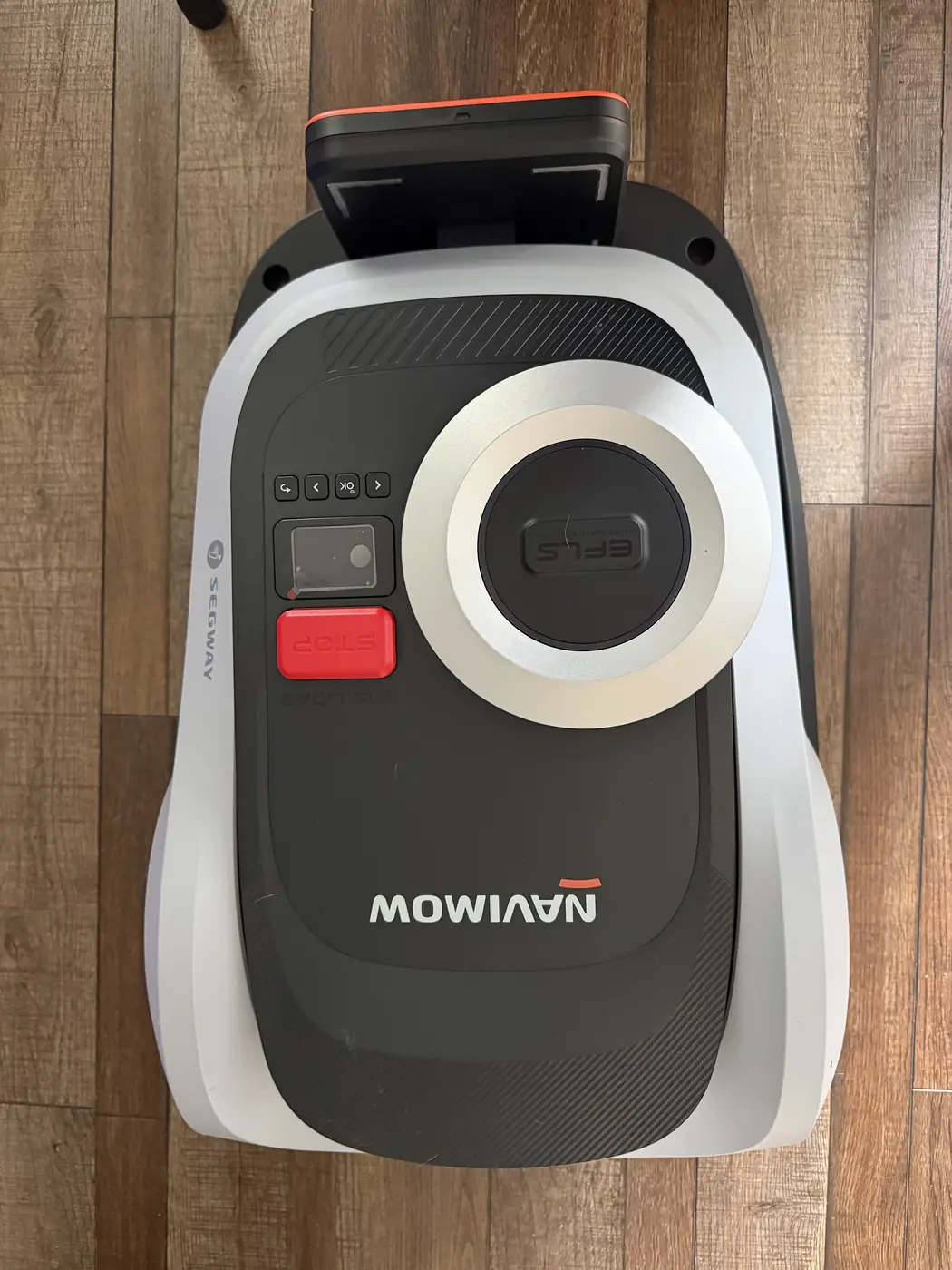
Topside, the control panel is refreshingly physical for a 2026 product: an illuminated EFLS dome, a genuine red STOP button, a small status display, and four hardware navigation keys. You can set cutting height and run a job at the machine without reaching for your phone, which sounds trivial until the app updates and you just want the thing to mow.
The number that should decide your purchase
It is not the slope rating and it is not the LiDAR. It is this: the i215 cuts about 4,585 square feet per charge, and the lawn it is sold for is 16,117 square feet.
That is roughly three and a half charge cycles to cover the rated area once. At 160 minutes of cutting followed by 130 minutes of charging, a complete pass over a full 0.37-acre lawn is a 24-to-48-hour proposition in elapsed time. Independent testing puts it in exactly that window, and our own reading of the manual produces the same arithmetic.
This is not a defect. Robotic mowers are designed to run continuously on a schedule and keep a lawn permanently cut, not to finish a job while you drink a beer. But it is a genuine expectation gap, and it is worsened by a labelling error: the manual heads that 4,585 ft² figure as "Area Capacity per Hour," which would imply the machine covers the full lawn in under four hours of cutting. It does not. Navimow's European spec sheet lists the same 426 m² figure as coverage per charge, and the independent measurement agrees. The US manual heading is wrong.
Practically: if your lawn is genuinely at or near 0.37 acre, run this mower on a near-daily schedule and let it maintain rather than catch up. If you want a machine that completes a property in one outing, you want a different category of product.
Segway Navimow i215 LiDAR — Full Specifications
Specs synthesized from Navimow User Manual rev 260129-A §2.3 Specifications (official), cross-checked against the Navimow product page. View source ↗
| Spec | Value |
|---|---|
| Cutting width | 8.66 in Amazon bullet copy says 7.1 in — that is the i1-series figure and is incorrect |
| Cutting height range | 2–4 in Low-cutting kit included in box; resulting range not published |
| Recommended mowing area | 0.37 acre (16,117 ft²) |
| Maximum mappable area | Up to 0.44 acre, layout dependent |
| Coverage per full charge | ~4,585 ft² (426 m²) Manual heads this "per hour"; EU spec and independent testing both place it per charge |
| Mowing time per charge | About 160 min |
| Charging time | About 130 min |
| Navigation | EFLS — solid-state LiDAR + vision dual fusion |
| LiDAR scan rate | ~200,000 points/sec, 230 ft range, 50 ms interval |
| Object detection | VisionFence — 200+ obstacle types at 0.4 in precision |
| Drive system | Rear-wheel drive with off-road wheels + Electronic Stability Control |
| Max incline — inside working area | 45% / 24° |
| Max incline — at boundary | 25% / 14° Omitted from all marketing material |
| Battery | Li-ion, 21.6 V DC, 7.65 Ah / 165 Wh |
| Blade motor rated speed | 2,500/min (100W peak, 6 blades) |
| Blade model | X3A06E Blades are disposable and excluded from warranty |
| Noise | 59 dB(A) sound power / 51 dB(A) sound pressure Per EN 50636-2-107, ±3 dB(A) uncertainty |
| Working temperature | 32–104°F (50–95°F recommended) Product page quotes -4–122°F, which is the storage range |
| IP rating | IP66 mower + dock, IP67 power supply |
| Zone management | Up to 20 zones, plus isolated zone mapping |
| Connectivity | 4G, Wi-Fi, Bluetooth; Alexa + Google Home |
| Net weight | 32.41 lbs |
| Dimensions (L × W × H) | 25 × 17.6 × 11.3 in |
| Warranty | 3 years mower, 2 years battery + adapter |
| Price | $1,599 USD* Price verified 2026-07-31 |
* Price reflects the listed value at 2026-07-31 and may differ on the vendor's site. Confirm the current price before purchasing.
Slope Performance — Segway Navimow i215 LiDAR
Insufficient owner data — manufacturer claim only (7 verifiable sources captured; minimum 5 required).
Sources (7)
- Blog — Segway Navimow (official) (2026-07-31)
- Blog — Navimow User Manual 260129-A (2026-07-31)
- Amazon — Segway Navimow (Amazon US) (2026-07-31)
- Blog — Segway Navimow Europe (2026-07-31)
- Blog — AndroidGuys (2026-07-31)
- Blog — The Home Depot (2026-07-31)
- Blog — Segway Navimow Support (2026-07-31)
The slope rating has a second half nobody prints
Every piece of consumer-facing material for this mower says 45% (24°). The manual says 45% (24°) inside the working area — and then, one row down, 25% (14°) at the boundary.
That second number is the one that will decide whether this mower works in your yard, because slopes in real residential lots rarely stop politely before the fence. A yard that grades away toward a back property line, a lawn that falls off to a retaining wall, a berm that runs to the sidewalk — all of those put the steepest ground exactly where the tighter 14° limit applies. If that describes your lot, the advertised 24° is not the specification you are buying against.
Two supporting facts point the same direction. The i215 is rear-wheel drive, not all-wheel drive — independent testing flags it struggling on steep side slopes, wet grass, deep ruts, and exposed roots. And Navimow's own support documentation recommends the i215 LiDAR for "flatter and larger" lawns while pointing hilly yards at the i2 AWD series — whose manual, we later confirmed, keeps 45% at the boundary rather than dropping to 25%. When a manufacturer's support desk quietly routes a customer segment away from a product, that is worth more than the number on the box.
Who this mower is — and isn't — for
The i215 LiDAR is the right machine for you if:
- Your yard has meaningful tree cover, tight sightlines, or a roofline that shades the sky. This is the flagship use case and nothing else at $1,599 solves it as directly.
- Your lawn is 0.37 acre or less and reasonably flat to gently rolling.
- You want zero siting work — no antenna, no wire, no sky survey. Nine minutes from box to dock is real.
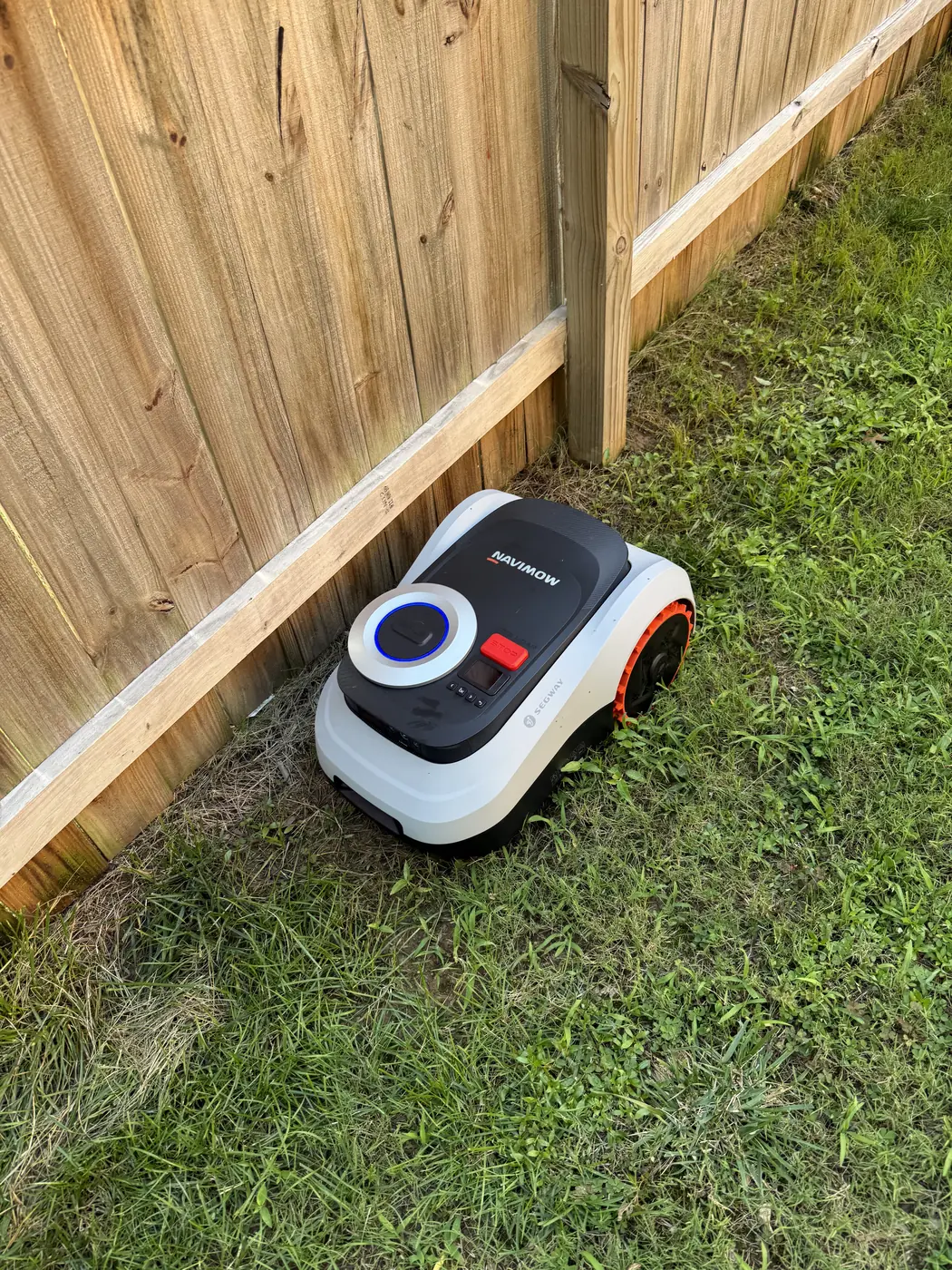
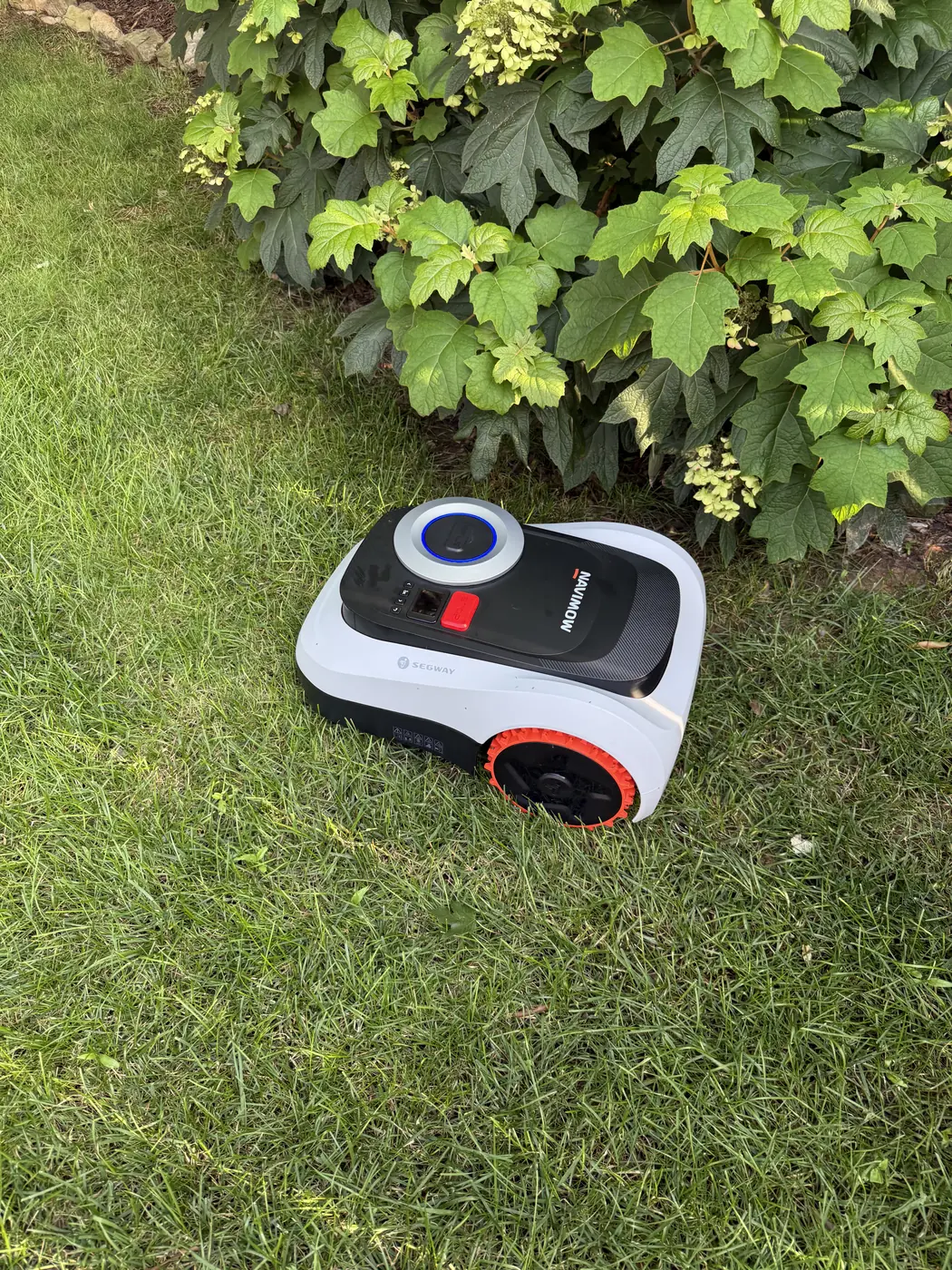
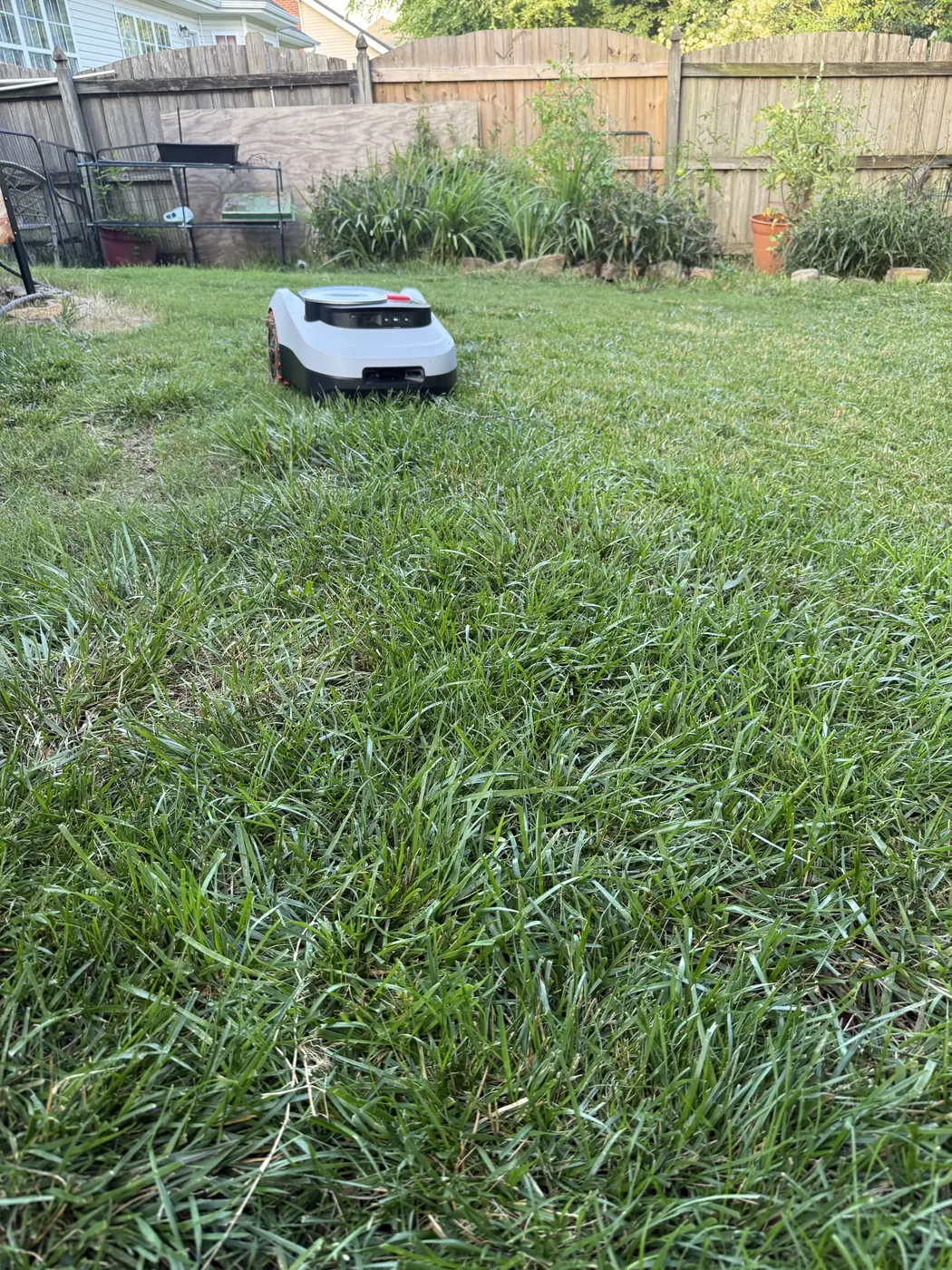
- Your yard is obstacle-dense: beds, shrubs, furniture, play equipment. VisionFence claims 200+ object types at 0.4-inch precision, and the overhanging-shrub case in the photos above is the kind of thing it is built for.
- You want it to run at night — a genuine option here, and at 51 dB(A) sound pressure it is quiet enough to be neighbourly.
Skip the i215 LiDAR if:
- Your slope runs to the boundary. The 14° boundary limit, not the 24° headline, governs that lot. Look at the i2 AWD series, which holds its full 45% rating at the boundary.
- You need sub-2-inch cutting for bermuda or zoysia. The published floor is 2 inches, and the included low-cutting kit's range is undocumented.
- Your lawn is meaningfully over 0.37 acre. At ~4,585 ft² per charge you are already at 3.5 cycles; pushing toward the 0.44-acre ceiling makes it worse.
- You want AWD traction for wet grass, ruts, or exposed roots — this is a rear-wheel-drive machine.
3-Year Total Cost of Ownership — Segway Navimow i215 LiDAR
Modeled across 0.37 acres of operating area over 3 years.
| Cost line | USD | Note |
|---|---|---|
| Purchase price (i215 LiDAR) | $1,599 | Navimow list price verified 2026-07-31 |
| 3-year electricity | $15 | 165 Wh pack, ~3.5 charges per full cut, 25 cuts/yr at 12¢/kWh, plus charging loss and dock standby |
| Blade replacements (3 years) | $144 | Blade Assembly Plus at $23.99, modeled at 2 sets/yr; blades are excluded from warranty |
| Connect+ 4G service (years 2–3) | $66 | Estimate only — first year included, ~$33/yr thereafter per independent reporting; i215-specific renewal pricing unconfirmed |
| Total | $1,824 | |
| Cost per acre per year | $1,643 | For cross-tier comparability |
The case for the Navimow i215 LiDAR
It removes the single biggest reason robotic mowers fail in real yards. RTK machines fail on tree canopy, and tree canopy is not something most homeowners can do anything about. Solid-state LiDAR plus vision makes that variable disappear, and it does so without a spinning assembly to knock out of alignment. Setup is genuinely nine minutes. GeoSketch real-scene mapping lets you edit boundaries against a recognisable picture of your own yard rather than an abstract blob. Twenty zones and isolated-zone mapping cover the detached-front-lawn case. It is quiet at 51 dB(A) sound pressure, IP66 rated so you can rinse it off, carries a 3-year mower warranty, and is stocked at Navimow.com, Amazon, and Home Depot — which matters more than it sounds for returns on a $1,599 machine.
The case against
Rear-wheel drive, in a category increasingly moving to AWD, with independent testing flagging wet grass, ruts, and exposed roots. A boundary slope limit of 14° that appears nowhere in consumer-facing material and will disqualify a lot of sloped lots. A coverage rate that turns the advertised 0.37 acre into roughly 3.5 charge cycles and 24–48 hours of elapsed time. A 2-inch cutting floor that rules out low-cut warm-season lawns, with an included low-cutting kit whose range nobody has published. Marketing that quotes the storage temperature range as an operating range, and an Amazon listing whose bullet copy carries the wrong cutting width. And a thin evidence base — 35 Amazon ratings at 4.3 stars and one readable independent hands-on is not much history for a first-generation platform.
What we still owe you on this review
Our unit is in hand and in service, and the observations above are what we can state from direct handling and dated photography. The following are measurements rather than impressions, and we will not publish numbers we have not taken ourselves. They are in progress and this review will be updated:
- Cutting height with the low-cutting kit installed — the one genuinely undocumented spec on this machine.
- Measured coverage on one full charge against the 4,585 ft² claim, on real grass rather than the manual's fresh-cut test lawn.
- Slope performance, measured separately for interior grade and boundary grade — the 24° and 14° figures deserve independent numbers.
- Sound pressure at 3 ft and 10 ft against the 51 dB(A) LpA spec, which the manual measured under no-load laboratory conditions.
- Overnight LiDAR runs under canopy — the core purchase rationale, and the thing most worth a controlled test.
- Edge and contour leave-behind, which independent testing flagged as narrow strips remaining around curves.
- Connect+ 4G expiry and renewal pricing as displayed in the app, since the figure on the product page belongs to a different model.
Sources & methodology (7 cited sources — first-hand unit in service since 2026-06-08)
- Segway Navimow i2 LiDAR — official US product page
- Navimow i2 LiDAR User Manual rev 260129-A (official, §2.3 Specifications) — the authoritative spec source for this review
- Segway Navimow i215 LiDAR — Amazon US listing (4.3/5 from 35 ratings at time of writing)
- Navimow i2 LiDAR — European product page (i208 / i215 / i220 variants and per-charge coverage figures)
- AndroidGuys — independent hands-on Navimow i215 LiDAR review
- Navimow i215 LiDAR — Home Depot listing
- Segway Navimow — i2 LiDAR support and coverage FAQ
Methodology: see Robotic Mower Review Methodology. First-hand notice: our i215 LiDAR unit was unboxed on 2026-06-08 and deployed to Rob's home test lawn on 2026-06-09. Every photograph on this page is our own, shot on those two dates; the nine-minute setup figure is read directly from those files' timestamps (16:51 to 17:00). Quantitative measurements listed under "What we still owe you" have not yet been taken and are explicitly not claimed. Where the official manual and Navimow's marketing conflict, this review follows the manual and says so.
Affiliate disclosure: the "Shop Navimow i-series" link above is our enrolled Impact tracked link, which lands on the Navimow i-series collection page; the Amazon link goes directly to the i215 LiDAR product listing. We earn commission on qualifying purchases at no additional cost to you. We do not adjust ratings or recommendations based on affiliate relationships. See our full affiliate disclosure.