Review and comparison · Yarbo Y Series
Yarbo Lawn Mower Review vs Lawn Mower Pro (2026): 150W vs 300W on the Same Core
The Yarbo Lawn Mower and the Yarbo Lawn Mower Pro are the same Yarbo Core carrying a different mowing module. Yarbo's Pro page says the Pro's dual 300W motors are double the standard 150W motors, and the Pro cuts down to 0.8 inches against 1.2 inches on the standard. Everything else Yarbo publishes (slope rating, battery, cutting width, add-on modules) is shared. On 2026-09-13, a new standard unit cost $4,999* on Amazon and the Pro cost $5,999*.
Bottom line first
- Pick the Pro at $5,999* if your grass is thick, wet or warm-season (Yarbo names Zoysia, St. Augustine and Bermuda), or if you think you will want the Pro cut later. Buying the standard and adding the Pro module costs $1,299* more than buying the Pro outright.
- Pick the standard at $4,999* if your lawn is cool-season grass that you cut often, and the $1,000* saving matters more than the lower cut height. You still get the same Core, slope rating and add-on modules.
- Neither model mows 6 acres in one session. A full 6.2-acre cut is about 25 charge cycles. See the charge-cycle math before you size a property to the rating.
Side-by-side spec comparison
| Spec | Yarbo Lawn Mower | Yarbo Lawn Mower Pro |
|---|---|---|
| New price (checked 2026-09-13) | $4,999* (Amazon) | $5,999* (Yarbo.com and Amazon) |
| Sold new on Yarbo.com | No. Refurbished only, $3,199* | Yes |
| Model name on Amazon | yarbo m1 | yarbo mpro |
| Cutting motors | Dual 150W | Dual 300W, 2,500W peak |
| Cutting height | 1.2-4.0 in | 0.8-4.0 in |
| Blades | Razor blades on cutting discs | Razor blades or optional straight blades |
| Cutting width | 20 in | 20 in |
| Max slope | 70% (35°) | 70% (35°) |
| Runtime per charge (Amazon listings) | 120 min | 120 min |
| Coverage per charge | ~0.25 acre (Seek & Score, not split by module) | ~0.25 acre (Seek & Score, not split by module) |
| Coverage rating | Up to 6.2 acres / 25,000 m² (Amazon) | Up to 6 acres (Yarbo.com) |
| Battery | 38.4 Ah Y Series battery | 38.4 Ah Y Series battery |
| Weight guidance (Amazon) | ~200 lb, 2 adults to assemble | ~210 lb, 2 adults to assemble |
| Snow blower / blower modules | Fit the Core, sold separately | Fit the Core, sold separately |
| Warranty | 2 years | 2 years, optional 3-year extension |
| Home Assistant API | No (per Seek & Score) | No (per Seek & Score) |
Green rows: shared. Amber rows: where the two differ.
Sources: Yarbo Lawn Mower Pro page, Yarbo store listings, Amazon listings B0FV2RX5L7 and B0FQTQ1M98, and Seek & Score. Sources disagree on sensor counts (Seek & Score: six cameras and four ultrasonic radars; Tom's Guide: six cameras and two), so we do not list one.
Where the $1,000* actually goes
Yarbo's published differences between the two come down to the cutting module. Nothing on the Core changes.
- Motor power. Yarbo's Pro page states the Pro "packs dual 300W motors—twice the power of the standard 150W—and delivers up to 2500W peak." Yarbo pitches the extra power at wet, thick and overgrown grass.
- Cut height and blades. The Pro goes down to 0.8 inches and takes optional straight blades ($90* for a pair). The standard listing stops at 1.2 inches on razor blades. A reviewer named Chris on Yarbo's Pro page says the straight blades let him cut an inch lower than the razors.
- Blade upkeep. Owner Tom.C, who has the Mower Pro, wrote in the Feb 2026 forum thread that his Pro blades need sharpening about monthly. He added that the standard kit instead needs its razor blades replaced to keep the cut quality high. Yarbo sells those as a 40-blade set for $39* and recommends replacement every 3 months.
The assumption to correct: the snow blower and leaf blower are not Pro features. They attach to the Core. A standard owner can add the Snow Blower Module ($1,299*) the same way a Pro owner can.
Yarbo Lawn Mower (standard) review
The standard Yarbo Lawn Mower is the Yarbo Core with the original mowing module. Amazon lists it as model "yarbo m1", and owners on Yarbo's forum and product pages call it the M1. Yarbo does not publish hardware model years. The CES 2025 Innovation Awards entry names the platform "Yarbo (2024 Model)", and the Pro module arrived later as the higher-power option.
What you get
- Specs from the Amazon listing: dual 150W motors, 20-inch cutting width, 1.2 to 4.0 inch cutting height, 70% slope rating, 120 minutes runtime per charge, coverage up to 6.2 acres (25,000 m²).
- Delivery and assembly: it ships in 4 boxes and weighs about 200 lb, and Yarbo recommends 2 adults for assembly.
- Positioning: the Data Center needs a 120° unobstructed view of the sky. Tom.C gives the same figure in the forum and says to mount it somewhere high.
- Where to buy it new: on 2026-09-13, Yarbo.com listed only a refurbished Yarbo Lawn Mower at $3,199* with a new battery. New units were on Amazon at $4,999*.
Official Yarbo Lawn Mower images
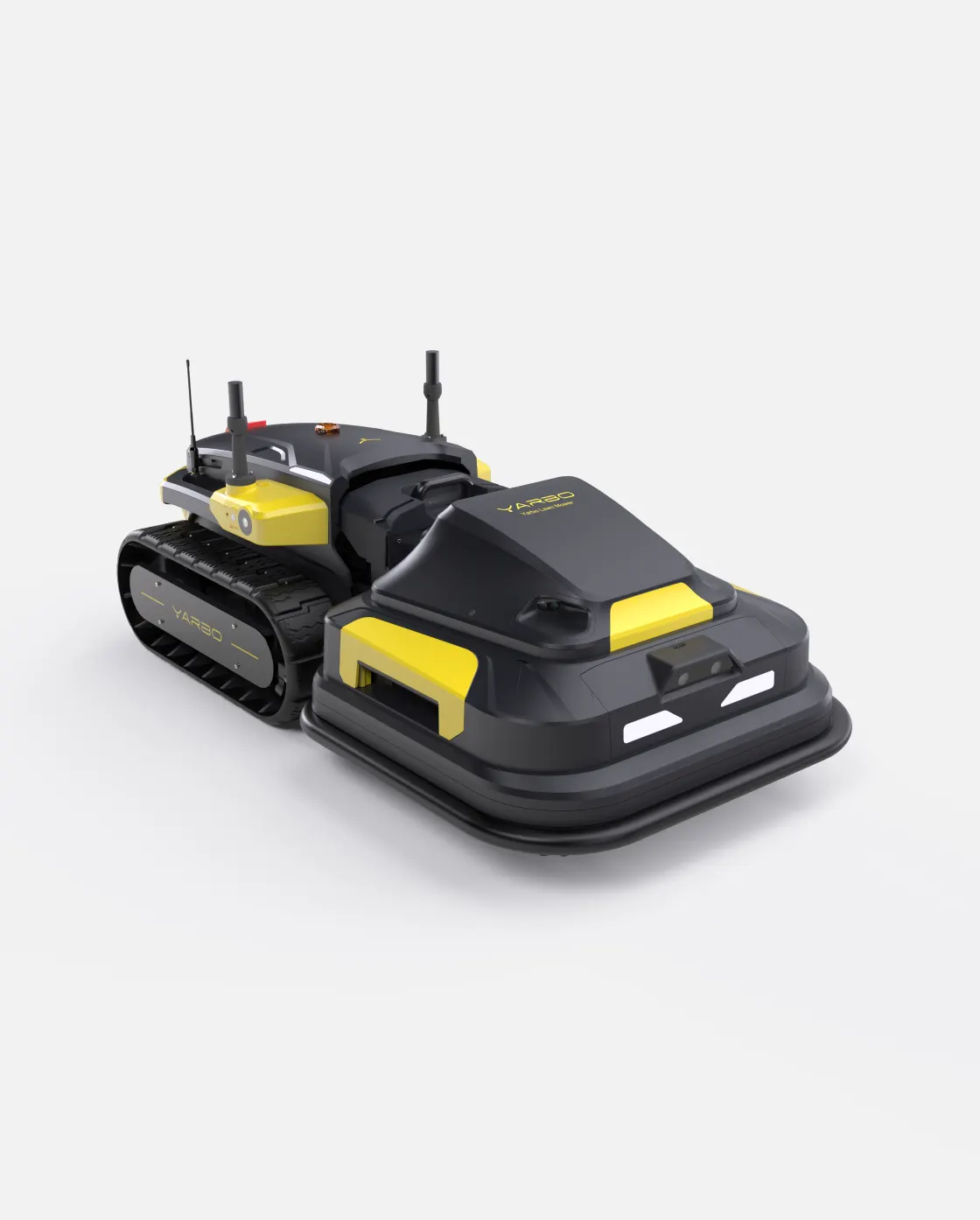
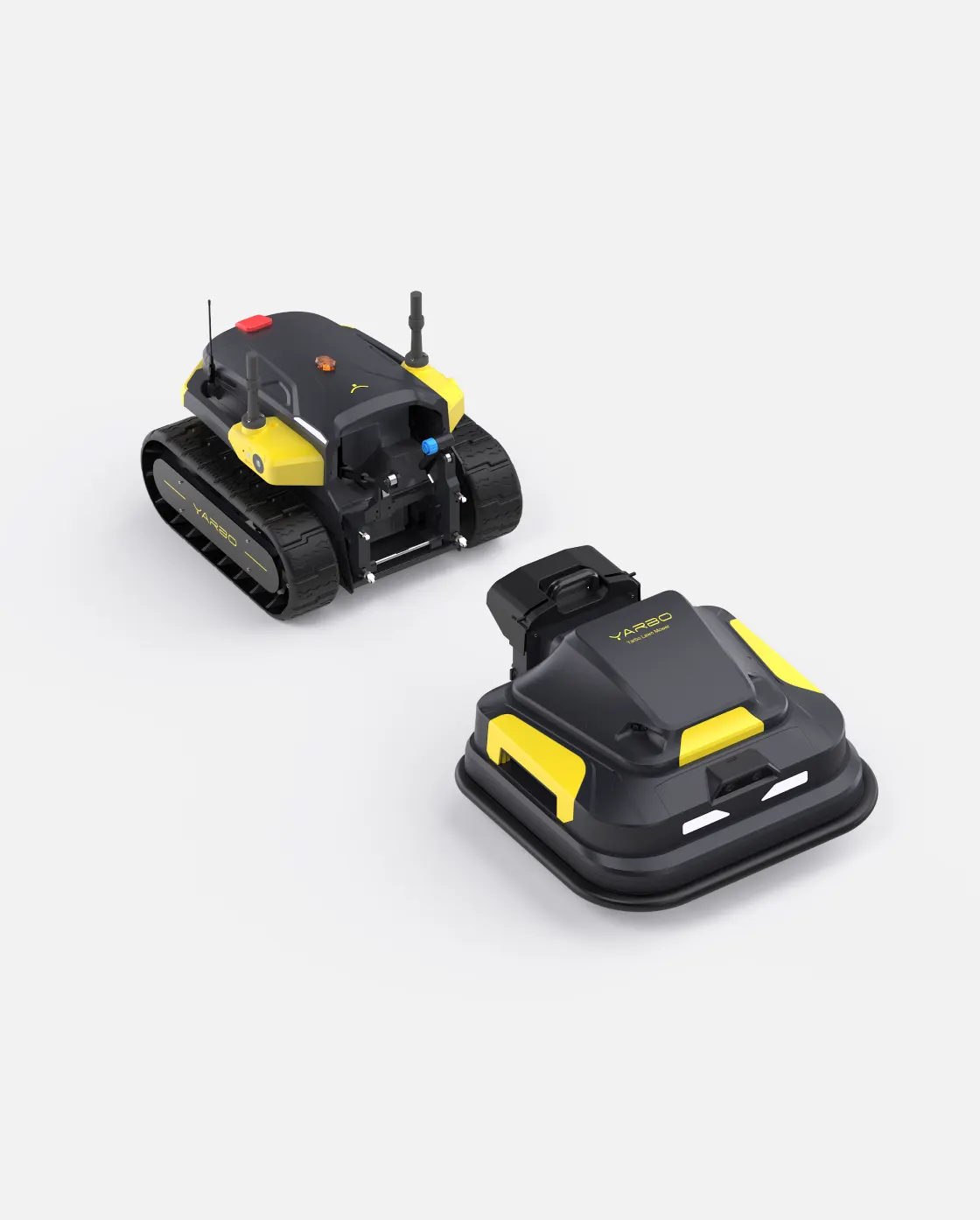

Images: Yarbo.com (manufacturer official assets).
What owners of the standard module report
The August 2025 forum thread "My experience with the mower" is the most detailed public account of the standard module. Its author, silvenz, owned the original module. Yarbo's own reply in the thread addresses "current M1 users", and silvenz mentions paying about 2K more for "a better model of the mower". His complaints cover grass packed down before the blades reach it, blades that jam with wrapped grass, wide margins around no-go zones, and repeated tracks beside defined pathways. A second poster, jules, agreed with most of those points. Jules did not name a module, and said the unit was doing "a decent reasonably reliable job" once the grass and work areas were dialed in.
“The castor wheels Pack down the grass BEFORE the cutting blades so there will always be grass that doesn’t get cut.”
“Grass builds up and wraps around the screws for the blades and the blades end up getting stuck rotated inwards and it stops effectively cutting the grass until you clear the stuck grass allowing the blades to once again rotate..”
One direct before-and-after comparison sits on Yarbo's own Pro product page. It is an undated, manufacturer-hosted review, so treat it as one owner's view. Reviewer Micheal C. switched from the M1 to the Pro module on thicker grass. He graded the M1's work a B- and the Pro an A- to A. He also said the Pro handled two weeks of growth better than the M1 handled cutting every 5 to 6 days.
The Tom's Guide review (Amanda Caswell, 13 October 2025) is titled as a Yarbo Pro test. However, the cutting height it reports (1.2 to 4 inches) and its 40 razor-type blades match the standard listing, not Yarbo's 0.8-inch Pro spec. Its embedded deal box is also the $4,999* 1.2"-4.0" listing. Read its setup findings as applying to the standard at least. Those findings are platform-level anyway.
“Getting the Yarbo Pro to actually work takes time, persistence, a good Wi-Fi signal, and for us, an entire weekend.”
“Yarbo excels on large, relatively open properties with good GPS signal. It struggles in dense, intricate gardens, very tight spaces, or situations where the owner needs a low-maintenance, plug-and-play experience.”
Verdict on the standard model
The standard is the same slope-capable Core with a weaker cutting head. The evidence against it is specific. Its owners report missed and flattened grass, and Yarbo later built a module with double the motor power and a lower cut height. The standard makes sense if you mow cool-season grass often and short. It makes less sense on dense warm-season turf, where Yarbo itself points buyers to the Pro. It also makes less sense as a stepping stone, because the upgrade math below costs more than buying the Pro outright.
What "6 acres" means for either model
The acreage rating is the number buyers size to, and it is the one most likely to mislead. Here is the arithmetic from published figures.
- Per charge: Seek & Score reports about 0.25 acre per charge cycle, running from 80% down to 20% battery.
- Rating: the standard Amazon listing rates coverage at up to 6.2 acres (25,000 m²). Yarbo.com says up to 6 acres for the Pro.
- Recharge: Yarbo does not publish a recharge time for the mower. The Snow Blower listing uses the same 38.4 Ah Core battery and rates it at 90 minutes from 20% to 80%.
The math: 6.2 acres divided by 0.25 acre is about 25 charge cycles for one complete cut. At 90 minutes each, that is about 37.5 hours on the dock per cut, before the robot mows anything.
What to do with it: a property at the top of the rating keeps the robot working every day of the week for about one full cut. Size your property against half the rating if you want a second weekly pass or any slack. Seek & Score's own "about 7 cycles in a day" works out to 1.75 acres per day by the same arithmetic.
What it costs if you don't: every day lost to weather, a GPS dropout or a rescue pushes the whole rotation back. GPS coverage and rescues are two of the common issues hmkb74 lists in the 2026 forum thread. hmkb74 owns two Yarbos and bought the second as a backup.
Can you buy the standard now and upgrade later?
Yes, and Yarbo publishes every price you need to check whether it pays.
| Path to a Pro-module Yarbo | Total | vs new Pro |
|---|---|---|
| New Pro ($5,999*) | $5,999* | · |
| New standard on Amazon ($4,999*) + Pro Module ($2,299*) | $7,298* | +$1,299* |
| Refurbished standard on Yarbo.com ($3,199*) + Pro Module ($2,299*) | $5,498* | -$501* |
If you already expect to want the Pro's cut, the new-standard route costs $1,299* extra and leaves you with a spare mowing module. The refurbished route is the only one that saves money. It also puts you on refurbished hardware. One reviewer on Yarbo's Pro page describes a refurbished replacement unit that arrived still linked to its previous owner.
Decision matrix: pick by lawn, not by budget alone
Pick the standard
Yarbo Lawn Mower, $4,999*
- Cool-season grass that you are happy to keep at 1.2 inches or taller
- You will run it often, so it never faces long growth
- You will not want the Pro module later (that path costs $1,299* more)
- You accept replacing razor blades on Yarbo's 3-month schedule
Pick the Pro
Yarbo Lawn Mower Pro, $5,999*
- Dense, wet or warm-season grass (Yarbo names Zoysia, St. Augustine, Bermuda and Kikuyu)
- You want a cut below 1.2 inches, or straight blades
- Mowing will sometimes slip a week or more
- You want to buy new from Yarbo.com
Yarbo Lawn Mower: current price
Yarbo Lawn Mower Pro: current price
What neither model changes
- Setup takes days, not minutes. Seek & Score says most users should expect "at least a full day, and many report needing a weekend or more." Tom.C describes a loop of mapping, test runs and corrections before the robot can be left alone.
- Support friction. Seek & Score reports users describing response-time friction with the China-based support team for U.S. East Coast customers. In his thread, silvenz says support repeatedly gave him shipping dates for a replacement that did not hold.
- No Home Assistant API. Per Seek & Score, Yarbo stated in March 2025 that it would not enable API access for Home Assistant. Control is through the Yarbo app.
- A smaller model is coming. In the 2026 forum thread, owner rgloverii writes that the upcoming M Series is designed for smaller suburban yards. The Y Series covered here targets large properties.
Frequently asked questions
What is the difference between the Yarbo Lawn Mower and the Yarbo Lawn Mower Pro?
Both are the Yarbo Core with a mowing module. Yarbo's Pro page says the Pro module's dual 300W motors are double the standard 150W motors, with up to 2,500W peak. The Pro cuts down to 0.8 inches and accepts optional straight blades; the standard Amazon listing gives a 1.2 to 4.0 inch range on razor blades. Slope rating (70% / 35°), 20-inch cutting width, battery and the add-on modules are shared.
Is the standard Yarbo Lawn Mower still sold new?
On 2026-09-13 Yarbo.com listed only a refurbished Yarbo Lawn Mower ($3,199*) and a refurbished lawn mower module ($1,299*). A new unit was listed on Amazon at $4,999* (ASIN B0FV2RX5L7, model "yarbo m1"). The Pro was listed new at $5,999* on both Yarbo.com and Amazon.
Can the standard Yarbo Lawn Mower use the snow blower or leaf blower?
Yes. The modules attach to the Yarbo Core, not to the mowing module. Yarbo sells the Snow Blower Module ($1,299*) and Blower Module ($1,099*) separately, and the standard Amazon listing says leaf and snow blower modules are sold separately. The snow blower is not a Pro-only option.
Can I upgrade from the standard Yarbo Lawn Mower to the Pro later?
Yes. Yarbo sells the Lawn Mower Pro Module on its own for $2,299*, and owners on Yarbo's Pro page describe switching from the original module. The math: a new standard at $4,999* plus the Pro module at $2,299* is $7,298*, which is $1,299* more than buying the Pro at $5,999*. If you already expect to want the Pro cut, buy the Pro first.
Can either Yarbo mow 6 acres at once?
No. Seek & Score reports about 0.25 acre per charge cycle (80% down to 20% battery). The standard Amazon listing rates coverage at up to 6.2 acres (25,000 m²). That is roughly 25 charge cycles for one full cut. Yarbo rates the Core battery at 90 minutes to recharge from 20% to 80% (Snow Blower listing), so one full cut of 6.2 acres carries about 37.5 hours on the dock before any mowing time. Yarbo does not state whether its acreage figure is per day or per week.
Did you test either Yarbo mower?
No. This page is research-only. It is built from Yarbo's store and product pages, the Amazon listings for both models, Seek & Score, Tom's Guide, and two Yarbo owner forum threads. Every source is linked in the Sources section.
Sources
- Yarbo Lawn Mower Pro product page (motors, cut height, slope, maintenance, warranty)
- Yarbo Lawn Mower Pro Module, Refurbished Yarbo Lawn Mower, Snow Blower Module, 38.4Ah Battery, Cutting Blades 40-pc and Straight Blades 2-pc store listings (prices checked 2026-09-13)
- Amazon listings: Yarbo Robot Lawn Mower, Dual 150W (B0FV2RX5L7), Yarbo Robot Lawn Mower Pro, Dual 300W (B0FQTQ1M98), Yarbo Snow Blower (B0FJF9V1JC) for the shared battery recharge rating
- Seek & Score, "Yarbo Modular Yard Robot Review", Kevin O'Shea, 12 March 2026 (updated 16 March)
- Tom's Guide, "I tested the Yarbo Pro robot mower", Amanda Caswell, 13 October 2025
- Yarbo forum, "My experience with the mower", silvenz and jules, 4 August 2025
- Yarbo forum, "Still worth buying in 2026?", Tom.C, rgloverii, hmkb74, Greg, c141medic, February to March 2026
- CES Innovation Awards 2025 honoree listing, "Yarbo (2024 Model)"
Methodology: see our robotic mower methodology. The Buy links on this page are Amazon listings carrying our Amazon Associates tag (lawncareguides-20). We earn a commission if you purchase through them, at no extra cost to you. See our full affiliate disclosure.
*Prices marked with an asterisk reflect the listed price at the time of review and may differ on the vendor's site.
Research-only comparison: we have not used either Yarbo mower. It is built from the manufacturer, retailer, reviewer and owner sources linked above, curated 2026-09-13.